Saturday, November 14, 2009

LECTURE 5 / 12 NOVEMBER 2009

From Samarkand to Chang’an: The Itinerant Sogdians
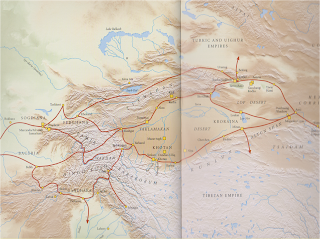
I. The Ancient Sogdian Letters
In 1907, under a Han dynasty watchtower northwest of Dunhuang, the Hungarian-British Archeologist Aurel Stein found a mail bag containing 8 letters written in the Sogdian language; 3 of them were too fragmented to read but 5 were relatively intact
B. Stein turned these letters to the British Museum; experts in the Museum and other experts began to try to translate them
C. After several trials and improvements over the past 100 years, we now know the complete content of these 5 letters
D. They were written by Sogdian merchants in 312 CE to other Sogdian merchants on the Silk Road or to their families in Samarkand

II. Who Were the Sogdians?
Sogdians were farming and trading people who lived in the Zarafshan River Valley in today’s Uzbekistan and spoke an Eastern Iranian language
They were ruled by Archamenids from Persia in 5th century BCE, Alexander (and the Seleucid Greek kingdom), and the Kushans.
Even though the Sogdians never had a united and strong kingdom of their own, they were very visible in Central Asia throughout its history.

III. The Rise of Sogdian Merchants on the Silk Road and Elsewhere
From 3rd to 10th century CE the dominant traders on the Silk Road were the Sogdians whose reach encompassed the Byzantine Empire, India and China.
Before the rise of Sogdians, Indians and Persians were prominent in the trade in Eurasia.
This may have been caused by the disruptions brought by Xiongnu’s westward and southward thrust, creating a vacuum for the Sogdians to fill in the central region of the Eurasian continent.
Therefore, not only were the Sogdians prominent in trade with China, but they were also active in South Asia and West Asia

IV. The Master Traders on the Silk Road
The ancient Sogdian letters give clear evidence that trade along the Silk Road mostly took place between Sogdian merchants some of whom were resident in various countries.
Since the Sogdians did not have their own currency, the common medium for trade was the Sassanian gold coins until the 7th century when Tang Chinese coins became the common currency in trade on the Silk Road.
Sogdian merchants brought spices, glassware, jewelry, medicinal material from the West to the East; they brought silk, tea and lacquerware.
They also traded rare animals, slaves, even singers, dancers and acrobats.

V. Sogdian Communities Along the Silk Road and in Eastern China
As trade developed, many Sogdians chose to stay in trading centers, forming their own community and having their own governing system as well as religious institutions (mainly Zoroastrian temples).
Historical records and archeological findings indicate at least 30 such communities from Kashgar in the west end of today’s China to Liaoning province in the northeast.
The leader of a Sogdian trade caravan was called a Sartpaw; the community leader of resident Sogdians was known by the same title.
This quasi autonomous communities often had their own armed forces, religious clergy and other administrative arrangements including the community coffer.

VI. The Integration of Sogdian Communities in the Chinese Society
The Sogdians were identified in Chinese historical records and other documents in the 3rd century.
Sogdians were also recruited into the army and often served in the imperial palace.
Almost all of the Sogdians who stayed in China took one of nine of the existing Chinese surnames; therefore, they were also known in China as a group of people with these nine surnames (“zhao-wu jiu-xing”).
During Tang dynasty, the Sogdians were known as good musicians and dancers; many of the roughly 3000 wine shops in Chang’an were run and staffed by Sogdians.
E. The central Chinese governments began to appoint the Sogdian community leaders as local officials with the title “Sabao”, the Sinicized version of Sartpaw.
F. During Sui and Tang periods, these Sogdian communities were integrated into the local administrative structure as regular “Xiang’s” or “Li’s”. (乡里)
G. Those Sogdian families who stayed in China long enough gradually became indistinguishable from the other Chinese.

VII. Contributions of the Sogdians to China
In addition to music and dance, the Sogdian clothing style became fashionable during the Tang dynasty.
Some rare animals from Africa and other places were introduced by Sogdians.
Sogdians brought their religious practices as well as artifacts which were merged in Chinese Buddhism.
The Sogdian script was later borrowed by the Uyghurs, Mongols and Manchus successively in their own writing system.
The Sogdian merchants greatly enhanced Chinese economy, enriching the material life in China.
Sogdians were mainly or at least partially responsible for the introduction of Zoroastrianism, Manichaeism, and Nestorian Christian faith in China.

VIII. The Most Infamous Sogdian in Chinese History
An Lu Shan (Roxan) was born in China of Sogdian parentage; he became a regional military commander in northeast China.
During the reign of Tang Xuan Zong An Lu Shan, though very trusted by the emperor, started a rebellion which nearly toppled the Tang dynasty and caused decline of Tang power from the point onward.
His rebellion was defeated by the Tang forces with help from the Arabs and Uyghurs.
An Lu Shan has since been a household name in China, in a negative sense.

LECTURE 4 / 3 NOVEMBER 2009

I. Two Examples of Revisionist History
A. An Early Christian Community in China [by HKC]
Ban Chao dispatched his associate Gan Ying to visit Roman Empire (97 CE); Gan reached the Persian Gulf but was told by the Persians that it was too dangerous to cross the turbulent sea; therefore, he returned without getting to the Roman Empire

B. Reason for Zhang Qian’s Mission


Grotto Painting in Dunhuang done in 4th century
Depicting the scene of Zhang Qian departing China with Emperor Wu bidding him farewell
Han army captured a huge statue, “Golden Man”, from Xiongnu who worshipped it because it was a statue of Buddha from the West
Therefore Emperor Wu sent Zhang Qian to the West in order to learn more about Buddha
Since Buddhism was the dominant religion in Central Asia and India at the time of Zhang Qing’s mission and since Zhang Qian was inquisitive about the region, e.g., commerce between Bactria and India, it was possible that Zhang Qian learned about Buddhism and reported this to the Emperor; but this was not recorded in the official history on his mission
At any rate, Zhang Qian could only have learned of Buddhism after he arrived in the Western Region
Buddhists did not make or worship statues of Buddha until the Kushan Period which began more than 100 years after Zhang Qian’s death
II. Monks from the West to China
A. Parthamasiris (c. 100 CE)
Prince of Parthian Persia, lost to his uncle in the succession and took the throne of Armenia; when Romans conquered Armenia, they proposed Parthamasris to be King of Parthian Persia.
Objections from the Persians forced him to seek solace as a monk in Buddhism
He was an erudite man and able to achieve a high-level understanding and interpretation of Theraveda (Hinayana) Buddhism
Coming to China c. 140 CE, he mastered the Chinese language in just a few years
In charge of translating Theraveda scriptures for 23 years (148-171 CE) and starting a new style of Chinese prose
Taking refuge in southern China during the turmoil at the end of Han Dynasty and died there
B. Lokaksin
A Yue-chi, arriving in the Han capital toward the end of Han Dynasty
Translated scriptures of Mahayana Buddhism for over 10 years (178-189 CE)
Disappeared from public view after this work
C. Kumarajiva (344∼413 C.E.)
Father was an Indian noble, mother was a princess of Qiuci (Kucha)
Followed his mother to a nunery at age 7
Became learned at a young age; well versed in Theraveda Buddhism and gained a wide reputation not only in Central Asia but also in China
After he declined to come to Chang’an to serve a ruler at the time, he was forcibly taken to inside the Chinese border by the ruler’s army (382 CE) and stayed 18 years near the border even after the ruler himself was disposed
In 401 CE he was taken to Chang’an by a new ruler and provided with a team of 120 Chinese monks to assist him in translating the Mahayana Buddhist works
Over 600 volumes were completed during his time
He was credited for a new method of translation which is relevant even today
Founded a new school of Buddhist philosophy which resulted in a new sect
Admired as a genius, he was “ordered’ by the ruler to marry ten maidens so that his talent can be inherited
III. Chinese Monks to the West
A. Zhu Shiheng (c. 250 CE)
First Chinese monk to go west in search of true Buddhist scriptures
Confused about the Buddhist literature’s correctness and authenticity, went to Khotan (Yu-tian) to learn more
Obtained 90 volumes and sent them back to Luoyang after overcoming difficulties
Died in Khotan at age 80
B. Fa Hsian (Fa Xian)
Born in 334 and died in 420 C.E.
Decided to become a monk when his parents both died
First Chinese monk to go to India
He was 60 when he started his long journey in the company of 10 Chinese monks
Took 6 years to reach Central India, stayed there for 6 years to learn the language and the scriptures, 2 years in the south, including today’s Sri Lanka, and 1 year to return home by sea
Wrote “Buddist-Country Records” after his return, detailing his experiences
A compendium of Buddhist temples, practices, geography and history of Central Asia and Indian
C. Sung Yun
A native of Dunhuang, worked in the capital city of Luoyang in early 6th century
Was sent by the Empress Dowager of the ruling dynasty to the West to present gifts and seek better scriptures (518 CE)
Reached Khotan and the Pamirs by passing through many small states
IV. The Story of Xuan Zang
Born (602 CE) into a family of intellectuals and officials
Entered monastery at 13 and became a ordained monk at 21
Spending five years visiting many Buddhist scholars and learned major classical Buddhist works
Puzzled by differences in these works regarding the ways to reach nirvana, decided to seek truth from India despite the dangers and difficulties involved
Upon return he was offered a ministerial post but declined; was given resources by the Emperor to translate the books he brought back
His style was much more fluid and elegant than the previous translators
But he was far more than a translator of Buddhist scriptures
He compiled, with the help of his disciple, a book on the West at the request of the Tang Emperor and gave vivid and detailed accounts of some 138 states he had visited
He was also the founder of the new Buddhist school based on the new philosophy he had helped to form while in India
The Great Tang’s Records of the Western World (Ta-Tang-Si-Yu-Ki)
On Xuan Zang’s Return to Chang’an
Xuan Zang stated that he saw this and described its precise location
Archeological work was done in early 20 century to uncover it
Asoka’s Pillar near the birthplace of Buddha
Erected around 300BCE; excavated around 1910
V. Impact of Buddhism in China
Introduced into China in the turbulent times in Chinese history; gained acceptance and grew in influence during the 400 years of turmoil in northern China
Buddhism, along with Taoism, provided comfort and a hope of after-life to people who suffered
Many rulers of the northern regimes were non-Han; they needed a form of worship that was different from Confucianism and Taoism
As a result, Buddhism took Chinese a characteristic; Theraveda which focused more on the individual was overlooked, Mahayana which emphasized helping others to achieve nirvana become the standard Buddhism in China, hence, Korea, Japan and Vietnam
Buddhist and Chinese philosophy influenced each other, resulting in transformation of both; in terms of Buddhism, it was the Zen school of Buddhism
VI. Between Body and Soul
Biological being and social being
Instinctive being, intellectual being and emotive being
Religion of salvation and religion of transcendental meditation
For discussion: What motivated the early Buddhist monks and what gave them strength?

LECTURE 2 / 15 OCTOBER 2009

I. Prelude
A. General Remarks
1. History is a function of geography; take China as an example
2. To understand history it is necessary to study not only the historical documents, which often record political events, military conflicts and diplomatic treaties, but also archeological findings, which provide material proof of the way a certain group lived. Historians also have to concern themselves with art and literature, linguistics and anthropology, trade and commerce, religious beliefs and social customs, technological development and economic conditions. Most importantly, it is necessary to examine the causality between different events and the circumstances that either strengthened or weakened the causality.
B. Consequences of Alexander’s Eastward Thrust
1. The Greeks in Bactria: Agents of East-West cultural exchange and fusion.
2.The Yue-chi (Tocharians):The exiles who became accidental conquerors and propagators of Buddhism to Central Asia and China.

II. The Use of Horses by Nomadic Peoples
Domestication of the horse gave the chariot and horse-riding warriors a huge advantage in battle. Shepherds on horseback could supervise much larger herds than on foot. Horse was until the train the fastest means of transport and communication.
Speed of the horse made long-distance trading easier.
The nomads thus had a great advantage over the settled farmers and the cities and towns supported by the farmers.
D. Nomadic tribes are generally not amenable to large centrally administered political organizations; the most common type of organization is a loose tribal alliance under the leadership of a strong leader who comes from a strong and large tribe. With horses, the rate of intermingle among nomadic tribes increased greatly, enabling the nomadic peoples on the Eurasian steppes to have frequent changes in genetic and linguistic characteristics, belief systems and social customs. Of course, they also traded more frequently both with other nomadic groups and with the settled societies.
III. The North-South Rivalry
Nomadic and farming societies either traded or engaged in wars
A pattern: Across the Eurasian continent, the peoples along the East-West axis mostly traded; the peoples along the North-South axis often had confrontations. This was because the nomadic people in the north needed goods produced by the farming societies in the south and possessed the military means to take what they needed by force.
In addition to satisfying their own needs, the nomadic people also re-sold goods they obtained from one farming society to another farming society for profit.
D. The settled population often resorted to bribing the nomadic raiders to gain peace, generally with an amount which would make looting unattractive.
E. Some farming societies responded to the threat posed by the nomadic people by adopting the costumes and horse-back fighting techniques of the nomadic people and/or by constructing walls along the perimeter of defense to stop the mounted raiders. (King Wu-ling of Zhao during the Warring States Period in China did this in about 350 BCE.)
IV. Confrontations between Han and Xiong-Nu (Huni)
A. Xiong-Nu (often referred to in Europe as Huns) gained recognition around 400 B.C.E. in the Yinshan region in today’s Inner Mongolia, to the north of Hohhot, and became a threat to the settled Han people during the last years of the Warring States Period. They took advantage of the strife between Han and Chu following the demise of Qin Empire in late 3rd century B.C.E., threatening Han Dynasty in its first century.
B. The early Han emperors resort to marrying Han princesses to Xiong-Nu chiefs, but this did not give them lasting peace as Xiong-Nu often raided Han cities despite the peace treaties.
V. The Strategy of the Han Emperors
To launch military offensive against the Huns
To find allies in the Western Region against the Huns in order to cut off the supply lines of the Huns from the West
To acquire superior horses for the Han cavalry
VI. The Missions of Zhang Qian
First mission (138-127 BCE)
Second mission (116-114 BCE)
VII. The Impact of Zhang Qian’s Missions on the East-West Exchange
A. From China to the Western Regions
• Silk, metallurgy, Chinese medicinal herbs (including ginger)
• Chinese writing and administrative system
B. From Western Regions to China
• Horses, clover, walnut, cucumber, onion, garlic, etc.
• Buddhism, music, dance, acrobatics, etc.
VIII. The Impact of Zhang Qian’s Missions on the East-West Exchange
VIII. Relations between Han China and Egypt, Rome, Persia
A. With Ptolemaic Egypt
• Trade developed both through the Silk Road and the Sea Route
• Some Alexandrian merchants lived in Central China
• Many archeological finds show the extent of Chinese imports from Egypt (e.g., glassware)
B.With Roman Empire
• China and Rome learned the existence of each other during Han Dynasty;
• Silk was the main Chinese export and Rome was the largest importer;
• Glass utensils and decorative glass beads were imported to China, so was woolen material and amber.
C. With Parthian Persia
• Lute (pipa) and harp (konghou), two important music instruments in Chinese music, were both imported from Persia via Central Asia;
• Archeological finds include winged-beasts; documents mentioned that ostrich and lions from Africa came to China through Persia and Central Asia
• Some Buddhist monks of Persian origin came to China and introduced Buddhism to China

HIST 48T/58L Updated Schedule

Lecture 1 (8 Oct 2009)
Alexander and his Eastern Thrust

Lecture 2 (15 Oct 2009)
Zhang Qian and the Opening of the Silk Road

Lecture 3 (22 Oct 2009)
Beauty of Loulan and the Tarim Basin During Han China

Lecture 4 (3 Nov 2009)
Buddhist Monks Bringing Scriptures to China (YD 106)

Lecture 5 (12 Nov 2009)
The Itinerant Sogdians

Lecture 6 (19 Nov 2009)
Battle of Talas – Midterm

Lecture 7 (24 Nov 2009)
Nestorians, Manicheans, Jews and Muslims in Tang & Song China (NH 202)

Lecture 8 (1 Dec 2009)
Mongol Rule

Lecture 9
Medieval Travelers

Lecture 10
The Timurids

Lecture 11
The Safavids and Uzbeks

Sunday, October 25, 2009

LECTURE 3 / 22 OCTOBER 2009

Beauty of Loulan and the Tarim Basin During Han China
I. Geography of the Western Regions
• Hexi Corridor
• Junggar Basin (between Altay Mountain and Tian Shan)
• Tarim Basin (between Tian Shan and Kunlun Mountain; Taklamakan Desert and the oases)
• Ili River (emptying into Lake Balkash)
• Fergana Valley (north of the Pamir Plateau)
• Transaxiana (east of the Aral Sea; between Syr Darya and Amu Darya)
II. After Zhang Qian’s Missions
• Han China seized the initiative and forced Xiong-nu to split into two groups.
• One group moved south and integrated in the Han population.
• The main body of Xiong-nu fled westward, displacing peoples on their way, driving some of them further west, ultimately causing Germanic tribes to invade Roman territories in Western Europe.
III. Early Settlers in Tarim Basin
Tocharians
• Tocharians (a term given by European scholars) moved into Junggar Basin before 2000 BCE; Indo-Europeans who spoke a western dialect, akin to the languages spoken by Celts, Hittites and Greeks.
• By contrast, Persians and Aryans who invaded India around 1500 BCE spoke an eastern Indo-European dialect (even though they were located to the west of the Tocharians), .
• Credited with bringing wheat to East Asia.
B. Scythians (Sakas)
• Scythians spoke an Iranian language, were an early group of Indo-Europeans who wandered on the Eurosian steppes. .
• Some migrated south and became settled farmers; the majority practiced pastoralism.
• They were known as Scythians, Sakas and Saizhong, by ancient Greeks, Persians and Chinese.
• First to domesticate the horse and to fight on the horseback.

REMARK: Tocharians and Scythians were the early settlers in Junggar and Tarim basins.

The Yue-Chi’s
• Yue-Chi’s were a Tocharian group which populated the Hexi Corridor, Qaidam basin and Junggar basin.
• They interacted with the Qiang group, speakers of a Sino-Tibetan language and related to Tibetans.
• Yue-Chi’s were driven out of Hexi Corridor by Xiong-nu and moved successively to the Ili River area, the Fergana Valley, Transaxiana, Bactria and Gandhara.
• A sub-group of Yue-Chi had populated the eastern part of the Tarim basin when Xiong-nu became powerful in the Western Regions.
IV. Hexi Corridor and the Oases States in Today’s Xinjiang During West Han
A. Administrative measures by Han dynasty
• Along the 1200 km Hexi Corridor, Han set up four counties with four garrison towns which were also centers of trade and cultural exchange.
• This administrative structure has remained for more than 2000 years.
• Han dynasty also extended its power in the Junggar and Tarim basins, stationed soldiers in key locations and constructed walls and beacon towers throughout the region.
• Han took Loulan in the east and Fergana in the west by force and established suzerainty throughout the Western Region, requiring each state to send a prince to Chang’an as a guarantee of its allegiance to Han.
• Since Xiong-nu was no longer a major player in the region, and since trade flourished between Han and these states, most of the oases states were under Han domination.
• Rebellion sometimes broke out, usually when there was internal turmoil in China proper.
V. Ban Chao and His Exploits
• Ban Chao (32-102 CE), from a prominent family, chose to be a soldier rather than a court official; he was sent to the Western Regions in 73 CE as the leader of a 36-man elite force.
• This elite force took daring and decisive actions in subduing adversaries and showed diplomatic skills in dealing with the various states on the oases in the Tarim Basin.
• Ban Chao subsequently worked to fend off occasional incursions of Xiong-nu and Yue-chi into these states, enforcing Han’s control over the Western Region and ensuring passage of the trade routes.
• In 97 EC, he sent an associate, Gan Ying, to visit the Roman Empire, but Gan Ying only reached the Persian Gulf. His report was interesting and useful.
• After serving in the Western Regions for nearly 30 years, Ban Chao pleaded with the emperor to allow him to return. But his plea was ignored.
• After his sister risked her own life to plea on his behalf, he was finally allowed to return home and died shortly after.
• Later his son Ban Yong was appointed to the same post and made further gains for Han Dynasty.
• It was about this period that Buddhism came to central China from the Tarim Basin.
VI. Loulan Kingdom
• Loulan was the eastern-most oasis state among dozens of small states ringing the Tarim Basin. Travelers from China proper must rest in Loulan before going forward.
• Its strategic location made it a center of commerce and a meeting point of different cultures.
• Due to shifting and drying of the river near it, Loulan became submerged under the sand around 1200 CE.
• However, many earlier Chinese poems made references to Loulan in romantic terms.
• The British archeologist Stein made two expeditions in early 20th century into the Lop Nor area and discovered the Loulan site, taking away many documents written in different languages, including Tocharian, Chinese and Khotan.
• Because of its geo-political importance, also due to the reputed beauty of Loulan girls, many rulers of the Tarim states took Loulan women as wives.
• Chinese archeologists found toward the end of 20th century many more artifacts at the Loulan site which demonstrate the multi-cultural character of Loulan as well as its close relationship with China proper.
VII. Shule Kingdom
• On a large oasis at the western edge of the Tarim Basin, with Fergana Valley lying just to the northwest of the Pamirs .
• Important to Han’s position in the Western Region, hence there were Han soldiers and civilians in Shule to ensure its allegiance.
• Sometimes under Xiong-nu threat but never conquered by them.
• Later known as Kashgar, always under the cultural influences of Persia, India and China
VIII. Yutian (Khotan) Kingdom
• At the southern edge of the Tarim Basin, just north of Kunlun Mountain
• Rich in high-quality jade and an important supplier to China for over 4000 years
• Residents were descendents of Scythians, with some Qiang elements
• Close-ties with Han and a major conduit by which Buddhism entered China
IX. Niya Kingdom
• Recorded in Chinese history books in detail, but no trace of it in recent centuries
• Stein made efforts to unearth it without success
• In 1994, a combined Chinese-Japanese team discovered its precise site and made extensive investigations
• Many treasures were found, among which is an embroidered elbow pad with Chinese characters and animals or legendary animals of Persia and Africa

Thursday, October 15, 2009

READINGS

Maps - PDF at Hisar Copy Center

"China: Five Thousand Years of History and Civilization" at Hisar Copy Center

“The History and Civilization of China” - PDF at Hisar Copy Center

“World Civilizations: The Global Experience”, Peter N. Stearns - Library Online Course Reserve - Course Code HIST 105

“Traditions & Encounters: A Global Perspective on the Past”, Jerry Bently and Herbert Ziegler - PDF at Hisar Copy Center

Wednesday, October 14, 2009

LECTURE 1 / 8 OCTOBER 2009


Overall Perspective

A. The Eurasian Continent
•The Eurasian continent is a contiguous landmass comprising some 55 million square kilometers or 3/5 of the total land area of the earth.
•A line drawn from the northeast corner of the Eurasian continent (northern part of Kamchatka Peninsula) southwestward to the southwest part of Arabian Peninsula (Aden) divides the landmass into two triangles.
•The lower triangle is warm and humid, with an annual precipitation of over 500 mm; this area contains some of the best agricultural zones of the world.
•The base of the upper triangle is generally dry and consists mostly of steppes and deserts; this area is mostly for herding or animal husbandry.
•North to the steppes are vast areas of coniferous forest; this area is mostly for hunting.
B. Comparison of the Eurasian Continent with the Americas, Africa and Australia
•Very large land areas spreading over mild weather zones of roughly similar weather patterns. Easier to communicate between East and West than between North and South.
•The availability of large animals that can be domesticated.
C. Routes of Exchanges Across the Continent
•East-West Exchanges: To the north, a “steppe route” used by the nomadic peoples; to the south, a “sea route” used by the coastal seafarers; in the middle, an “oasis route”, used by the agricultural peoples.
•North-South Exchanges: Orhon River to Chang’an, a main trade route between the nomadic tribes and the farming people along the Yellow River; from Tibet to the Tarim Basin and further north to the Junggar Basin; from Central Asia down to Afghanistan and then to India; from the eastern coast of the Mediterranean to Anatolia, Astrakhan etc.; Constantinople (Istanbul) south to the Mediterranean and Egypt and north to the Black Sea, thus East and North Europe.
•These networks of communications have allowed from very ancient times the exchanges of goods, social practices and ideas.
D. Means and Effects of Exchange
•Exchange among different groups are natural in human experience. These contacts have resulted in racial and cultural integration for the most part. The exchanges sometimes take the form of war, but mostly through peaceful means.
•However, wars have been effective catalysts for cultural adaptation and integration.
•The peoples in the East first developed a very sophisticated civilization, including technologies, sciences, social institutions and writing systems; these were adopted and integrated by the Greeks in the West.
•Alexander the Great was a product and a symbol of the Greek civilization; his expedition to the East brought a further integration and fusion of these two types of culture. Philip II (382–336 B.C.E.) of Macedonia unified Greece and decided to conquer the East. His son Alexander continued his unfulfilled ambition by leading a Greek-Macedonian army to the East.

I. Persian Empire

II. Classical Greece

III. Wars between Persia and Greece

IV. Alexander the Great and His Eastern Thrust


Alexander the Great and the Hellenistic World

Ptolemy’s Rule of Egypt
* Ptolemaic Dynasty
* Ptolemy’s Support for Culture
* Seleucus Ruled the Asian Territories

Economy and Culture of the Hellenistic Period

Four major cities of the Hellenistic Period

Alexanderia
•Built by Alexander in 332 BCE.
•Becoming an important city in the world and a center of Greek culture within 100 years.

Pergamum
•Capital of Attalid kingdom.
•One of the most important and beautiful cities in the Hellenistic period.
•The Pergamum library was next only to the Alexanderia library in size and importance.

Antioch
•Established by Seleucus I in 330 BCE
•It was the western terminal point of trade from Asia to the Mediterrenean region.
•The third largest city (next to Rome and Alexanderia) of the Roman Empire, with temples, theaters, aquaducts and public baths.

Athens
•Declining in importance during the Hellenistic period, Athens often needed financial support from the other rulers.
•Rulers of the Ptolemaic dynasty donated a statium next to the Theseus Temple.
•The Ptolemaic rulers offered their favorite god Isis in the temple in Athens.
•Athens remained a center for philosophy and culture along with Alexandria.

Trade Networks
•The Mediterrenean was joined with Indian Ocean
•India and East Africa were connected by ships following the mansoons
•Roads connected Asia Minor, Central Asia and India
•The central governments of each region maintained the roads with military garrisons to allow the merchants safe passage as well as to levy the trade taxes.
•“The Silk Road” began to take shape
•The main trading cities were Taxila, Bukhara, Merv, Palmyra, Antioch, Tyre, Alexandria, etc.

V. The Influence of Alexander’s Eastern Thrust
•There are estimated some 80 cities which were named Alexandria in today’s West and Central Asia.
•Many legends in the Persian speaking world are based on Alexander, corrupted to be Iskander and glorified in many literary works, e.g., Shahname by Firdausi (Firdevsi).
A. The Nature of Hellenistic Culture
•The Hellenistic culture in essence was a fusion of the Greek culture and the Asian cultures of the regions conquered by Alexander.
•Alexander was convinced that the Eastern peoples were not barbaric as Aristotle had taught him but cultured in their own way; he sought to fuse the two cultures by encouraging racial and cultural integration. For example, he married two Asian wives and began to wear Persian costumes. He also encouraged 9,000 Greek soldiers to take Perisan wives at a large wedding ceremony.
B.Bactria and Gandhara Culture
•Greek Rulers of Bactria
•Bactria was in today’s Afghanistan near Pakistan. The Greek generals who ruled this area became independent of the Seleucid rulers based in Damascus in 2nd century BCE.
•Buddhism which began in India was introduced to this area around this time.
•A majority of the Greek population in Bactria adopted Buddhism.
Gandhara Art
•Buddhists in India originally did not images of Buddha, believing that it was impossible to portray him.
•However, the Buddhists in Bactria felt a need to worship Buddha with the human image. Hence, they applied the Greek sculpture and painting techniques to Buddha and other deities.
•This was the possible because Bactria was far away from the center of Buddhism.
The Spread of Gandhara Art
•The Gandhara art spread to Central Asia and from there to China; it also propagated to Southeast Asia via the sea route.
•Exchange and fusion of different cultures have always existed; the appearance and spread of the Gandhara art is a case which can be clearly traced to its origin with documentary evidence and archeological findings.